
Construcciones Yamaro: Contractors look to hybrid excavators as costs rise

Rising fuel costs are putting pressure on Australia’s construction industry, making the fuel efficiency of heavy equipment an important consideration for contractors.
Recent ABS data from the June 2026 Business Conditions and Sentiments survey shows 85 per cent of construction businesses were negatively impacted by fuel prices or availability, while 87 per cent of construction businesses reporting increased operating expenses cited fuel prices as a contributing factor.
Komatsu Australia national business manager for construction Mark Boyes says the current environment is putting a renewed focus on hybrid excavators – a technology the company has been developing for almost two decades.
Komatsu introduced the world’s first commercially available hybrid hydraulic excavator in 2008 in response to rising fuel prices. Today, its hybrid technology continues to provide contractors with a way to reduce fuel consumption and emissions without compromising productivity.
“When fuel prices rise, even relatively small improvements in fuel efficiency can make a difference to the bottom line,” says Boyes. “Hybrid technology takes that a step further because it allows us to recover energy that would otherwise be lost and put it back to work. Customers can reduce fuel consumption while maintaining, and in some applications increase, the productivity and performance they expect from their excavator.”
Related stories:
- Komatsu and Atlassian Williams F1 Team extend partnership
- Aaron Kumar reflects on 20 years at Komatsu
- PAD Civil and Komatsu advancing civil construction
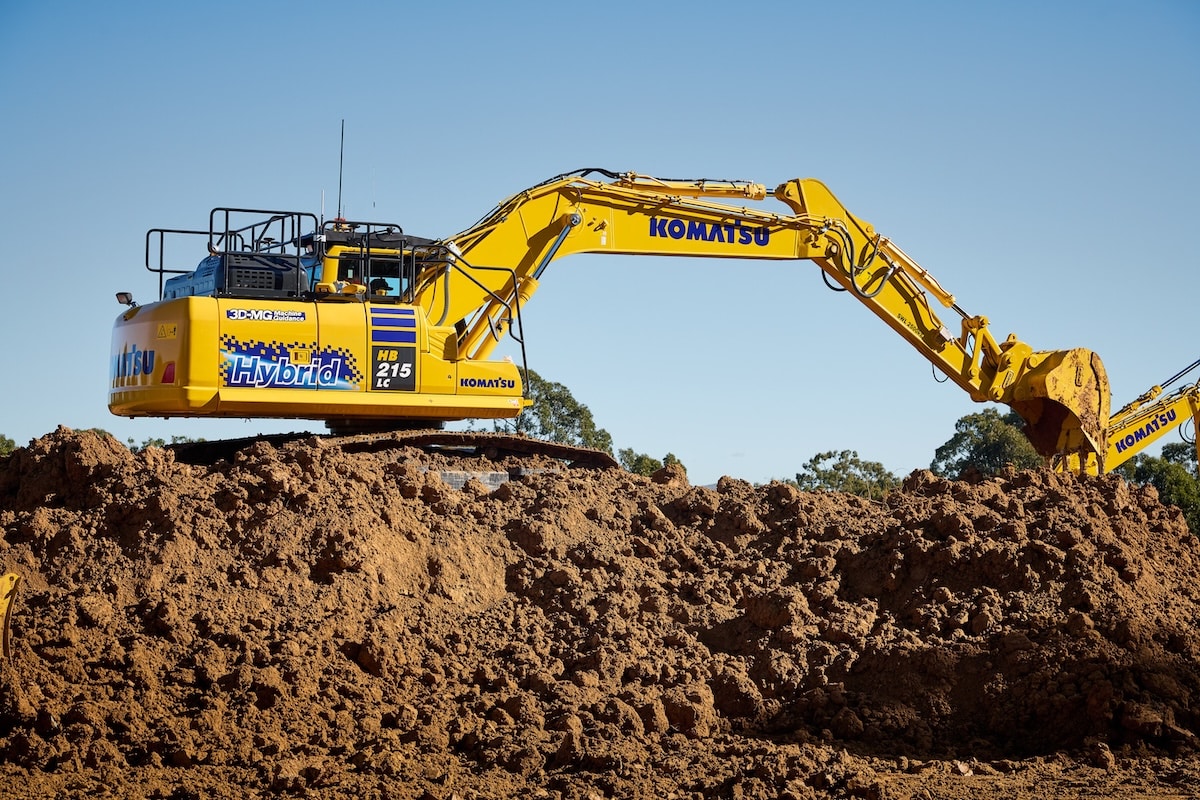
Komatsu’s hybrid system captures energy generated as the excavator’s upper structure decelerates during slewing, converting it into electricity and storing it in an ultra-capacitor. The recovered energy is then used to assist the machine during operation, reducing demand on the diesel engine.
Applications involving frequent, repetitive slewing therefore provide more opportunities to recover and reuse energy.
“If you’re working a stockpile and loading trucks, you’re continually digging, slewing, unloading and slewing back again,” says Boyes. “That repetitive cycle is exactly where hybrid technology can come into its own. The more opportunities the machine has to recover energy through the slew cycle, the greater the potential benefit.”
Komatsu customer Andy Divall from Goulburn-based civil contractor Divall’s Earthmoving has experienced those benefits firsthand. He purchased Komatsu’s first hybrid excavator in Australia in 2008 and has continued to use hybrid machines within his fleet, particularly for crushing applications.
“A standard excavator might burn around 16 litres of fuel an hour, while the hybrid can do the same work on around eight litres,” says Divall. “That’s about a 50 per cent reduction in fuel burn in the right application, which is a massive saving for us.”
Komatsu’s hybrid excavator range includes the 23-tonne HB215LC-3 and the 38-tonne HB365LC-3, both designed to deliver fuel savings while maintaining the reliability, productivity and quality of build expected from Komatsu machines.
“There’s no single fuel-saving figure that applies to every work site, but when a hybrid is working in an application that plays to the strengths of the technology, the savings can be substantial,” says Boyes. “That’s what makes understanding the customer’s operation so important. It’s about putting the right machine into the right application and helping them get the greatest possible return from the technology.”
While the construction industry’s focus on lower-emission machinery continues to grow, Boyes says the immediate economic case for hybrid equipment is equally important.
“With fuel costs putting pressure on contractors, we’re encouraging our customers to consider where hybrid excavators could fit within a fleet and deliver meaningful savings,” he says. “For the right application, you’re using less fuel to get the same job done, and that’s good for both the customer’s bottom line and their emissions.”
The post Contractors look to hybrid excavators as costs rise appeared first on Inside Construction.
View Source


Comments
Post a Comment