Posts

Showing posts with the label engineering

Is it possible to remodel without demolition?

Image
  When talking about  remodeling interior spaces , one thinks of knocking down walls, removing floors and generating debris, dust and annoying noise. Remodeling without demolition refers to a way of  redecorating  interior environments without the need to tear down a single wall, remove ceramics or modify facilities, instead some techniques are put into practice that allow having a new decoration without going bankrupt. Tips to implement remodeling without demolition Include good lighting A central lamp can be used to give the entire room the necessary light to enhance the decoration. Natural light is also important. Change the furniture and other objects of place If a piece of furniture that is in the room does not attract attention, it can be moved to another room and vice versa, this allows the spaces to have another aspect. Divide spaces To divide spaces, other structures are used, such as screens, a shelf that has height, curtains, blinds, etc. Change the color ...

Characteristics of polycarbonate roofs

Image
Terraces  are very important places within a home. It is very important that it has a cover so that people can be protected from both the rain and the sun, and polycarbonate roofs are ideal, due to their  resistance, beauty and durability ; they come in varieties of shades which are what determine the amount of sunlight these surfaces will get. What are polycarbonate roofs? They are sheets made of a soft, resistant material that can be easily molded, allows sunlight to pass through without being abrasive and adapts to all types of decoration as they are available in a variety of colours. They are very useful for any season as they provide protection on both rainy and sunny days. Types of polycarbonates for roof installation Ribbed polycarbonate sheets:  they are characterized by being very durable and high protection against solar rays. Smooth compact:  they are sheets of a thermoplastic material that can be cold bent, easy to cut, work and install. Cellular polycar...

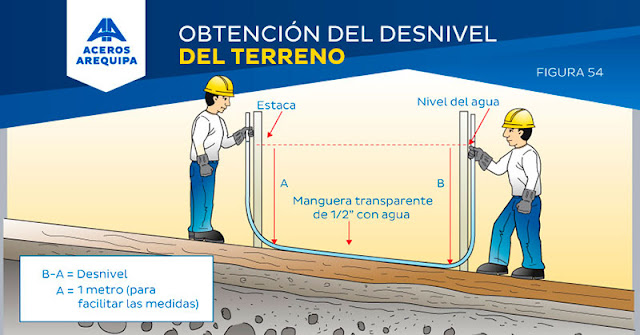
Hose leveling technique

Image
The hose leveling technique consists of transporting or passing reference  points to level  a surface using a transparent plastic hose filled with bubble-free water and any remaining dirt. Steps to perform leveling with hose A hose of approximately 10 meters is used, which is connected to a water faucet and filled almost completely. To execute this procedure, we explain the steps to follow: Preparation of the hose The hose is filled with water and a space of around 10 to 15 centimeters should be left between the edges of the water and the ends of the hose. Determine the starting point A mark is made one meter above the floor; the edge of the water contained in one end of the hose is brought close to the marked point. Then another person will take the other end to the new point, where the ends of the hose are left free and the water will try to reach its natural level. Level with the hose Then, the water edge of the hose is matched with the starting point until the wa...