
Construcciones Yamaro: Floating titanium shows promise for marine infrastructure
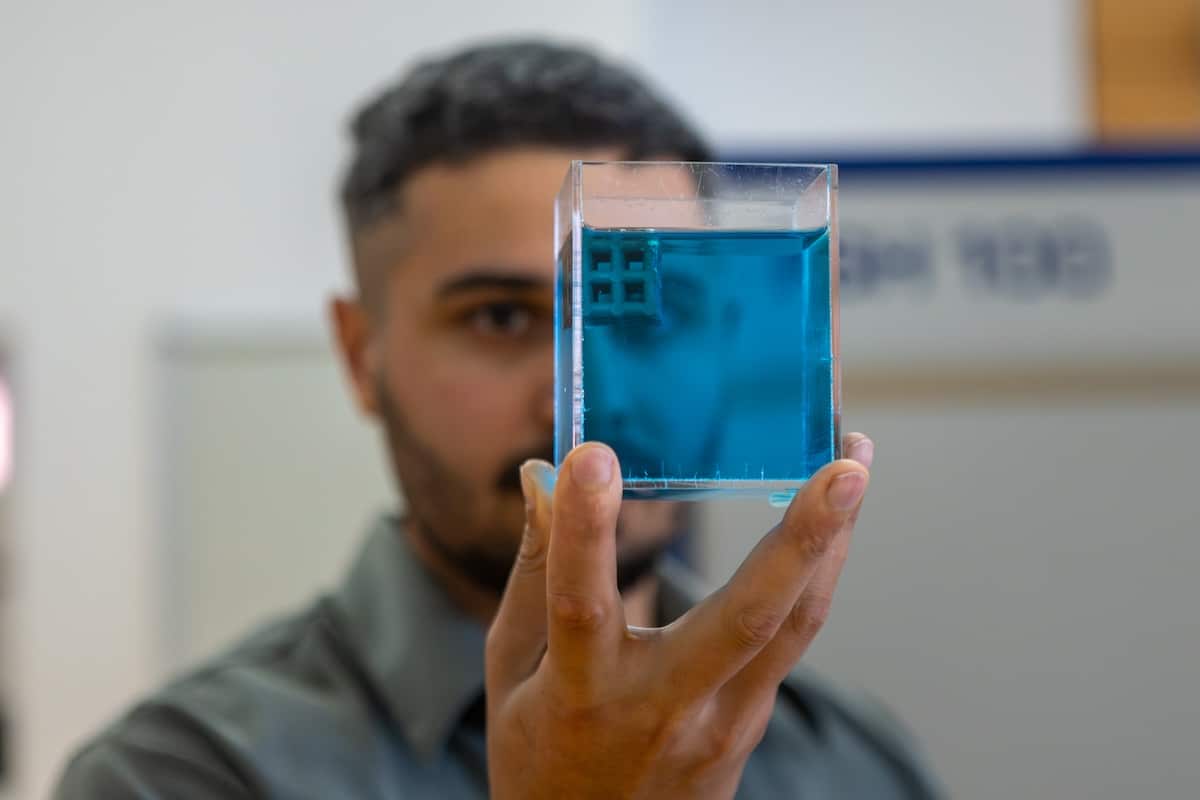
Australian engineers have developed a strong and lightweight titanium material that can float even after sustaining severe damage, with potential uses in marine infrastructure.
Research led by RMIT University shows the 3D-printed titanium lattice – made up of hollow, interconnected struts filled with foam – not only floats but also withstands seawater exposure. It is also stronger than stainless steel or high-density plastic currently used in jetties, buoys and floating sensors.
Lead researcher from RMIT’s Centre for Additive Manufacturing, Dr Jordan Noronha, said the team’s latest creation has overcome a fundamental challenge in making metallic lattice structures float.
“Although metallic lattices can be incredibly light – with densities less than one-tenth the density of water – their open, interconnected spaces allow water to enter, causing them to sink. This has made these strong, lightweight structures unsuitable for marine infrastructure – until now,” said Noronha.
“By filling only the hollow titanium struts with polyurethane foam, we created a structure that allows water to flow through it while remaining buoyant even after significant cracking and damage.”
The study is the first reported demonstration of a floating metal-hybrid lattice metamaterial, with samples remaining buoyant in freshwater for more than two months.
Rethinking density
To achieve this advance, the researchers developed a new measure, called skeletal density, to predict whether open structures will float.
Conventional density calculations include all the open space within a lattice structure, even though water can occupy this space and it therefore does not contribute to buoyancy.
Skeletal density instead considers only the parts of the structure that exclude water: the titanium walls and sealed, foam-filled channels.
“This gives engineers a simple design rule: if the skeletal density is lower than that of the surrounding liquid, the structure will float – even when water flows through all its external openings,” said Noronha.
Strong, light and resilient
Testing showed the team’s titanium structure was 70 per cent stronger than the stainless steel or high-density polyethylene widely used in marine applications when compared at the same overall density.
It also performed well in short-term corrosion testing using natural seawater from Melbourne’s Port Phillip Bay: after two weeks of immersion, the lattice lost only 0.15 per cent of its mass while its strength declined by less than 1 per cent.
Noronha said the hybrid lattice remained buoyant even after severe damage, including cracking, failure at key connection points and the fracture of an entire lattice layer.
It sank only after being severely crushed and compacted, highlighting its potential to maintain flotation despite major structural damage.
“Tiny, sealed cells in the foam trap gas and prevent water from flooding the hollow struts,” said Noronha. “In this way the foam acts as a distributed barrier that helps the structure remain afloat after damage – unlike conventional hollow marine structures, which can rapidly fill with water after cracking.”
Prototype buoy passes seawater test
The team demonstrated the technology with a 3D-printed marine buoy that remained stable in a turbulent seawater tank rotated up to 45 degrees, without needing a sealed casing, protective coating or extra flotation.
Project leader distinguished professor Ma Qian said next steps include scaling up the demonstration parts and testing long-term performance under realistic marine and deep-sea conditions.
He said the structure is also highly tailorable, and the group is open to exploring a range of other applications beyond marine infrastructure.
“By changing the material inside the titanium framework, we could tailor a similar structure for energy absorption, thermal management, vibration control and other applications,” he said.
RMIT’s Centre for Additive Manufacturing led the project in collaboration with the Conservatoire National des Arts et Métiers in France. The Australian Research Council and RMIT’s School of Engineering supported the research.
Organisations interested in partnering on the research can contact research.partnerships@rmit.edu.au
The post Floating titanium shows promise for marine infrastructure appeared first on Inside Construction.
View Source


Comments
Post a Comment