
Construcciones Yamaro: Transmutation sets the terms for decarbonisation
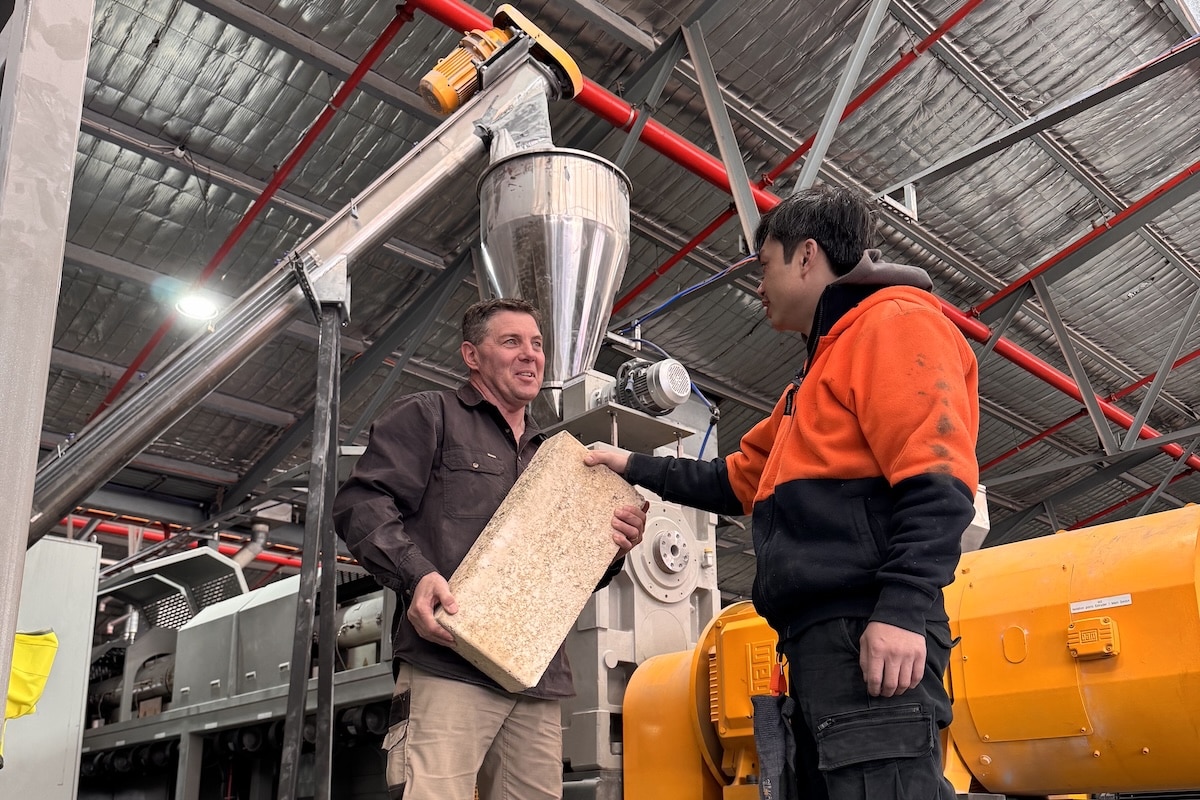
Transmutation is building sustainable, data-backed supply chains for construction, aligning material innovation with commercial and compliance pressures.
Contractors now require more from suppliers than product compliance alone. Scope 3 reporting has moved emissions accountability from aspiration to verification. Materials, transport and subcontractor inputs must be quantified, not estimated. The challenge is no longer identifying alternatives but securing inputs that can be traced, measured and defended.
Transmutation defines its role in construction through control of sustainable supply chains, not through individual products. The business operates across sourcing, processing, material engineering and delivery, with verified emissions data attached at each stage.
From source to site
Founder Brad Scott describes the company’s current phase as an expansion of an established model, calibrated to the pressures now driving contractor decision-making.
“The expansion is about scaling up what we have been doing previously. That is taking hard-to-recycle products that would traditionally go to landfill or don’t feed into standard recycling streams, and converting them into high-grade materials,” he says.
“Transmutation is now doing this at scale across Australia, with a different product offering designed to deliver greater value to the construction industry and beyond.”
Scale is measured by reach across the supply chain, not throughput. Transmutation sources material from Australian waste streams, processes it domestically and converts it into engineered materials that meet, and in some cases exceed, construction specifications. Each stage is controlled and traceable, allowing origin, processing and finished product to be tracked with precision.
The same process is applied to multiple waste streams, including Dulux powder coating waste, which Scott describes as a world first in converting it into higher-grade products.
“For us, it comes down to knowing exactly who we work with and making deliberate choices about our partners and sourcing,” he says.
“We source materials directly from Australian waste streams, so we know from the outset that the waste is generated locally. All processing is then carried out in Australia, giving us full visibility of the supply chain. We know where materials originate, whether that is from a specific council or region, and we have that data from the very beginning.”
Where the pressure sits
This level of visibility targets a structural gap in construction’s sustainability agenda. Reporting obligations have accelerated, but supply chains haven’t kept pace. Data is often incomplete, inconsistent or unverifiable, leaving contractors to rely on assumptions that are increasingly difficult to justify.
“Construction companies now need to report on Scope 3 emissions, not just Scope 1 and 2, and require accurate data from suppliers,” says Scott. “With Transmutation, that data is available and internationally verified.”
Environmental product declarations (EPDs) underpin that capability. Each product is supported by independently verified lifecycle data, allowing emissions to be quantified at material level and incorporated directly into reporting.
“We produce EPDs for all of our products, allowing organisations to understand the carbon being introduced into their supply chain,” says Scott.
Contractors are now operating under converging commercial and regulatory pressure. Verified data is becoming a condition for participation in large-scale projects. It is also becoming a factor in procurement decisions, particularly where government and project clients mandate sustainability performance as part of contract criteria.
At the same time, procurement models continue to prioritise cost and established relationships, exposing a misalignment that is widely acknowledged but rarely resolved. Contractors are expected to meet stricter sustainability requirements while operating within frameworks that haven’t materially changed.
“Procurement models are largely set up in opposition to sustainable outcomes unless there is external pressure,” says Scott. “They are typically driven by price and existing relationships, both of which can limit the adoption of new and innovative solutions.”
Transmutation’s response is to remove that tension by aligning cost, performance and data. Its materials are engineered to meet specification, supported by lifecycle analysis and carbon tracking across the supply chain, and priced to compete with mid-range alternatives.
A model that holds up
A prime example of this approach is Resin8, Transmutation’s synthetic aggregate, produced from hard-to-recycle plastics and able to be recycled again as an aggregate. Designed for use in concrete and asphalt, it addresses both material demand and environmental impact.
It is already being applied in partnership with Sustainable Concrete Group, where Resin8 is used alongside sand derived from processed solar panels in an effort to produce what Scott calls “the greenest concrete available in Australia”.
“We are the only company in Australia converting hard-to-recycle plastic into synthetic aggregate that doesn’t leach or create pathways to microplastics,” he says.
Aggregate is a core input in construction. Introducing an alternative that meets engineering requirements while carrying verified environmental data shifts the conversation from substitution to system change.
The commercial implication is also immediate. Used within precast elements and limestone products, Resin8 reduces weight while maintaining structural performance, lowering transport costs and simplifying handling.
“For example, a B-double load of our limestone blocks with Resin8 can be around two and a half tonnes lighter compared to the same product without it, which is a meaningful saving per truckload,” says Scott.
The impact isn’t limited to the product itself. It contributes to entity-wide sustainability and commercial viability, with contractors assessing materials as part of a system that includes sourcing, transport, installation and lifecycle performance.
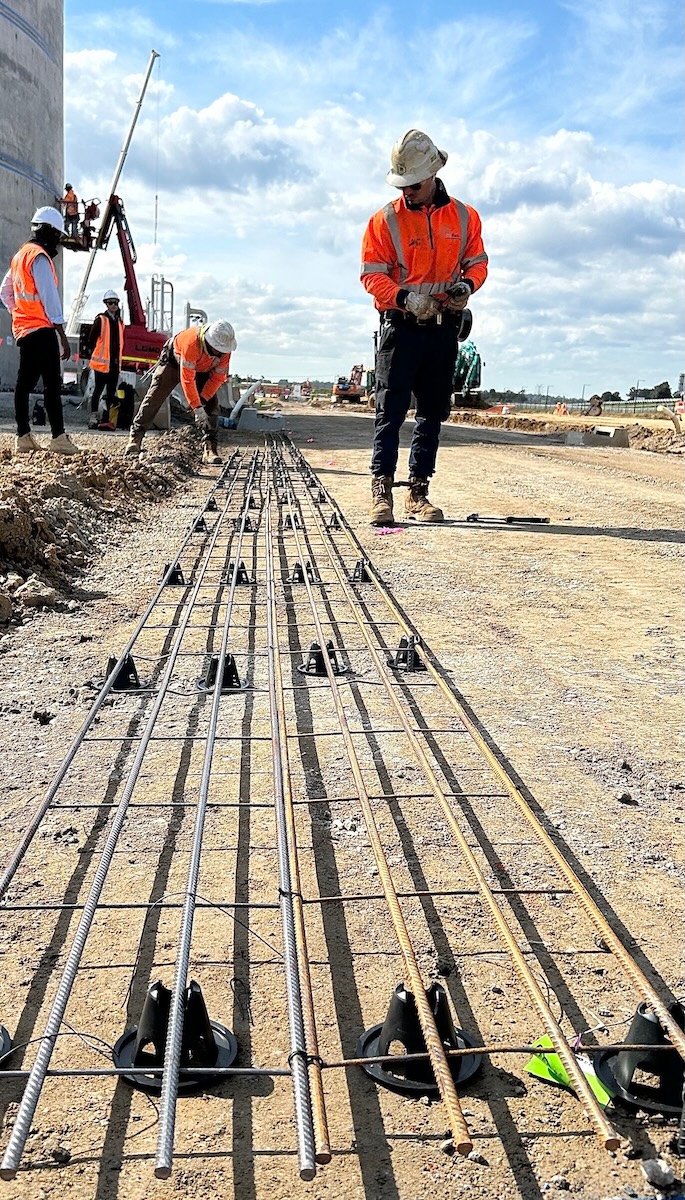
The bar chair, made from the company’s PostPrime recycled plastic, provides a different type of evidence. Scott says Transmutation’s bar chairs are rated to 200kg and are the only products of their kind in Australia supported by an EPD and lifecycle analysis.
“They are stocked in Mitre 10 stores, where they compete with lower cost imported products,” he says. “That combination of price competitiveness and verified performance challenges the assumption that sustainable products must carry a premium.”
The product serves as proof that performance, cost and verified data can be aligned within a single material solution, moving the barrier to adoption away from price and toward specification and procurement behaviour.
Early contractor involvement allows these considerations to be addressed upfront. Transmutation’s wheel stop, also made from PostPrime plastic, was developed through direct engagement with project requirements.
“Early contractor involvement allowed us to design the product with a clear understanding of its end use and market requirements,” says Scott.
“There were three key innovations. The first was structural design, ensuring the plastic wheel stop could withstand vehicle loads without cracking. The second was integrating and protecting embedded technology within the product. The third was improving installation, allowing the technology to be prepared off site and simply fitted on site.”
Developed in partnership with parking guidance technology provider Park Agility, the product functions as both a wheel stop and an Internet of Things housing. It shows how early alignment of design, material selection and application lifts both sustainability and performance outcomes. The product has already been deployed at Western Sydney Airport.
In each case, the same model applies. Transmutation operates across the full supply chain, aligning material inputs, processing, product design and data within a single framework.
“From collecting raw material, to processing it into a product, to supplying that product into the infrastructure sector, we are involved at every stage,” says Scott.
That approach is supported by formal certification and industry recognition. Transmutation has secured ISO certification for quality and environmental management systems, been ratified as a member of the UN Global Compact Network Australia, and received the Lifecycle Design Award for its wheel stop at the SIM-PAC Sustainability Awards.
Together, these credentials indicate a business positioning itself for scale, not niche adoption.
The market is still adjusting. Sustainability is now embedded in procurement and reporting, but adoption remains uneven. Scott says greenwashing is part of that transition.
“We are now in that phase where sustainability is considered important enough that some attempt to replicate or overstate their position,” he says. “We are also seeing increased scrutiny, with regulators taking action on greenwashing.”
It means sustainability claims must now be supported by data that can withstand audit and regulatory attention. Supplier integrity becomes a risk consideration as well as a procurement factor.
Transmutation sources materials locally, processes them domestically and tracks each stage of production, providing a level of traceability that is difficult to achieve in fragmented supply chains.
“Provenance is critical. With virgin plastic, unless it has been directly sourced, it can be difficult to know where it has been manufactured,” says Scott.
“Transparency in where materials come from, particularly recycled materials, is crucial. Australia still imports recycled material despite the volume of plastic waste generated locally.
“Supply chain resilience is also important. If materials are sourced locally, products can continue to be manufactured even during global disruptions. This provides stability in both supply and pricing, rather than being exposed to volatility in overseas markets.”
He summarises the business in direct terms: “Our difference is looking across the entire supply chain and focusing on outcomes that aren’t only beneficial for the environment, but also commercially viable for the market. If we can produce high-quality, best-in-class products that support the circular economy, that goes a long way in gaining acceptance.”
Environmental performance now sits alongside cost, compliance and delivery certainty in construction decision-making. Data links those elements. Transmutation connects material development with supply chain control and verified reporting. Its products are applied in project delivery and its data used in procurement and compliance. For a sector now required to account for what it builds as well as how it builds it, that combination is fast becoming expected.
The post Transmutation sets the terms for decarbonisation appeared first on Inside Construction.
View Source


Comments
Post a Comment