
Construcciones Yamaro: Bringing the Groote Eylandt wharf back to berth
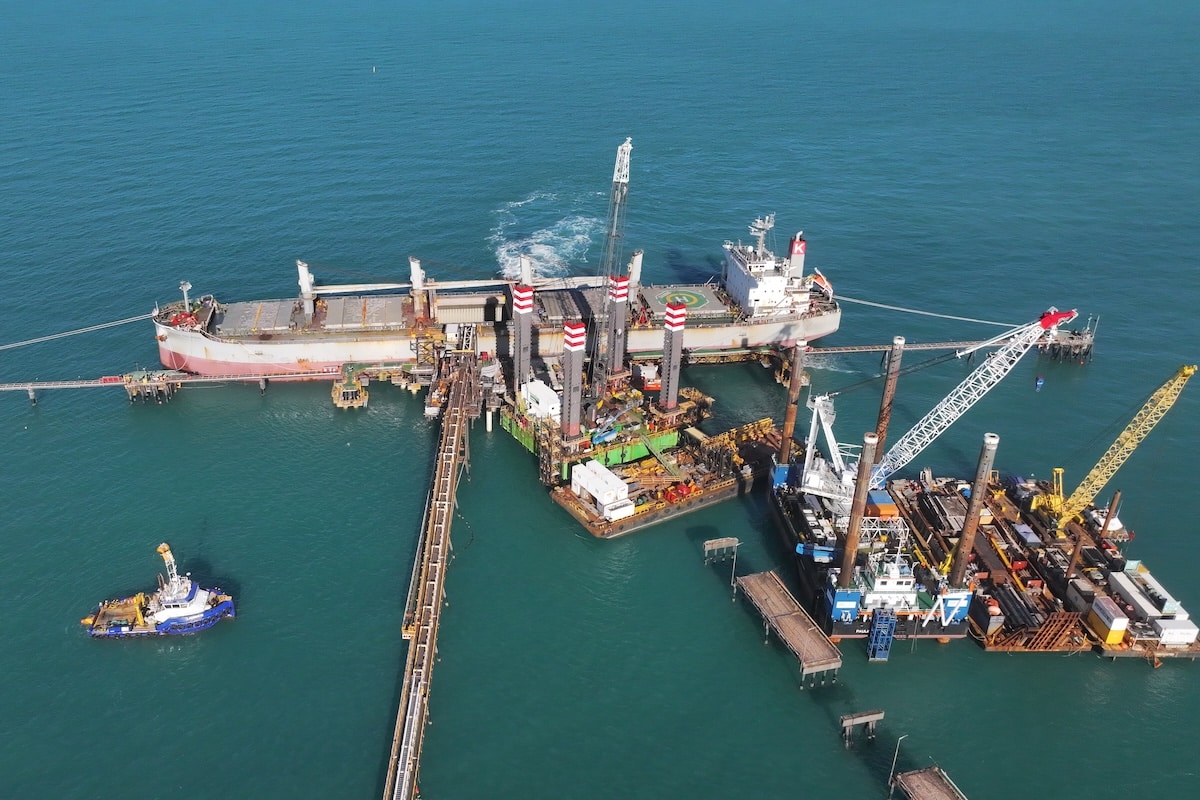
Tropical Cyclone Megan didn’t leave a wharf to repair at Groote Eylandt. It left a twisted, partially submerged structure that had to be dismantled before anything could be rebuilt.
On 18 March 2024, Tropical Cyclone Megan shut down the Groote Eylandt wharf, cutting off the island’s only manganese export line and bringing a globally critical operation to a standstill. The wharf, operated by Groote Eylandt Mining Company (GEMCO), a South32 and Anglo American joint venture, is central to the island’s manganese exports. Without it, stockpiles build quickly and production becomes unsustainable.
According to South32, it is the world’s largest producer of manganese, with Groote Eylandt a key source of supply. The disruption placed immediate pressure on global supply and the Northern Territory economy, with flow-on impacts for jobs and government revenue.
What followed wasn’t a conventional rebuild. It was a tightly sequenced operation working through a collapsed structure, a debris-strewn seabed and a highly constrained marine environment. McConnell Dowell was engaged to deliver a program that spanned mobilisation; stabilisation; demolition; reconstruction of the wharf; electrical installation, energisation and commissioning; and completion and handover.
The brief was simple in definition and unforgiving in execution: restore export capacity as fast as safely possible.
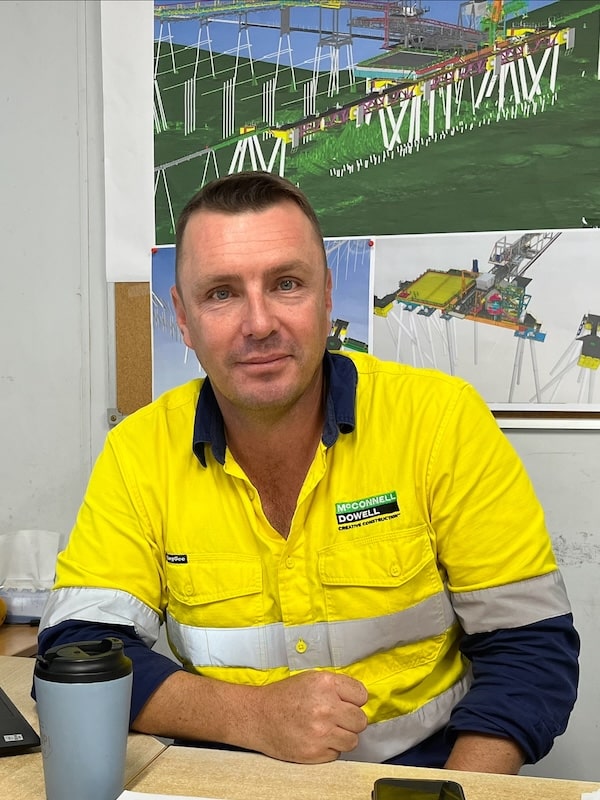
Gert Olivier, operations manager for Queensland and the Northern Territory at McConnell Dowell, was part of the team working through it from the outset.
“The critical objective across all phases was achieving ‘first ore on ship’. The first ore milestone became the focus of all design, procurement and construction decisions. Once first ore was achieved, the remaining works could be completed within operational restrictions,” he says.
“The question was: how do we get a structure in place that allows a vessel to berth, and how do we get the conveyor system running so that material can be loaded?”
Getting to first ore meant mobilising quickly in a remote location where access, logistics and sequencing were already working against the program.
Moving people in and out of site was a task in itself. Each phase of the project demanded a different mix of skills, from marine and piling crews to riggers, welders and scaffolders.
Mobilisation timelines added another layer of complexity, with it typically taking two to three weeks to get a person on site due to medicals and inductions. Workforce planning had to stay ahead of the program.
Within two months of the cyclone, crews were on site. A jack-up barge was the first major piece of equipment mobilised, allowing stabilisation and demolition to begin.
Soon after, a marine fleet was assembled from across Australia, Singapore and the UAE – two large jack-up barges (Santa Fe and Pauline), two smaller jack-ups (Sealift 2 and Sealift 6), a 250-tonne crane barge, three flat-top storage barges, and a support fleet of tugs and work punts.
“The first priority was stabilising the remaining structure, particularly the shiploader and the contactor house,” says Olivier. “These were critical components that could be retained.”
With initial stabilisation in place, salvage works began with seabed clearance, as large volumes of cyclone debris needed to be removed before piling and installation commenced. At the same time, damaged steel above the waterline was stripped back while retaining key elements.
To support this, detailed scans were used to build a model of the structure in its damaged state, forming the basis for sequencing and the design of temporary stabilisation works.
Related stories:
- McConnell Dowell drives consistency through its PMO
- McConnell Dowell turns to virtual reality to raise plant awareness
- McConnell Dowell sets a disciplined course for digital advancement
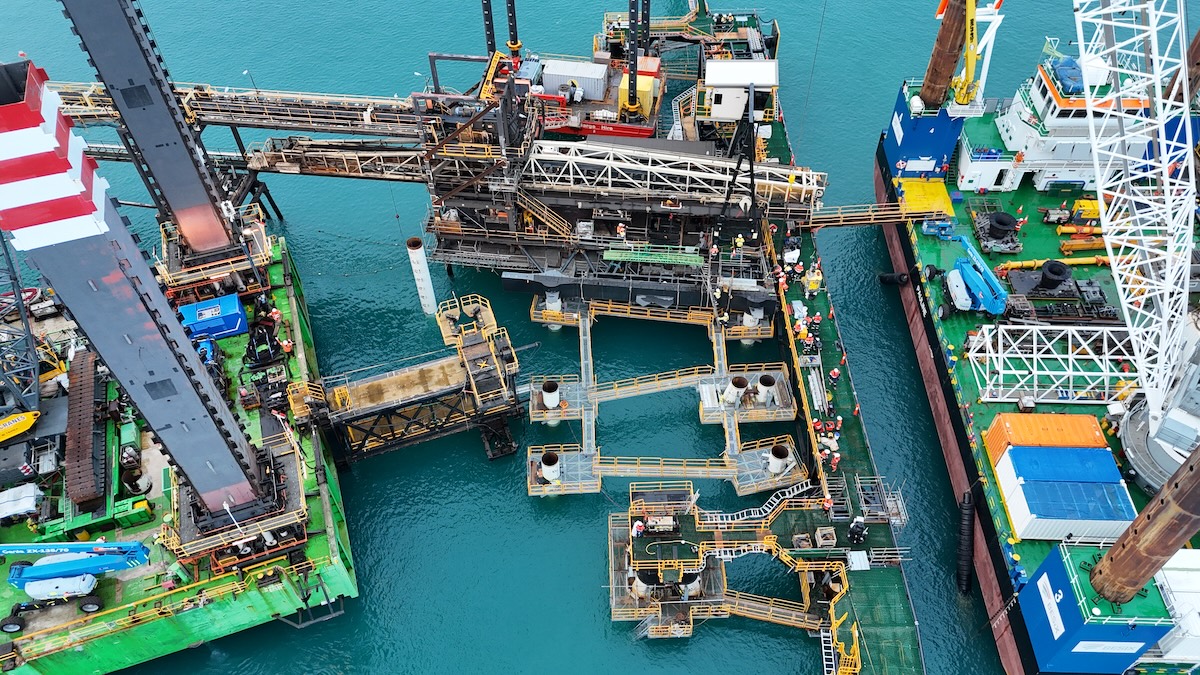
“One of the difficult aspects of the project was dealing with what we referred to on site as ‘spaghettified steel’,” says Olivier. “The cyclone had twisted and deformed the steel structure to such an extent that it was wrapped around piles, bent in multiple directions, and in some cases partially suspended.”
Mechanical methods were used initially, with hydraulic shears cutting sections of steel away, but the condition of the material introduced further risk. Stored energy within the structure meant that cutting one section could release forces elsewhere, causing the steelwork to shift or collapse unpredictably if it wasn’t carefully controlled.
“We had to develop detailed cut plans and carefully sequence every action. We had a designer working with us on site to continuously evaluate the condition of the structure,” says Olivier. “Each time we removed a section, we had to stop, reassess and replan the next steps. It was a controlled and methodical process.”
Some sections could be removed directly; others were cut and allowed to fall to the seabed, where divers salvaged the debris at a later stage.
Once the debris from above the waterline was removed, dive teams were required to cut, segment and rig submerged elements for salvage from the seabed. Working in low-visibility conditions and within tight tolerances around the existing structure, the dive teams salvaged a total of 1,037 tonnes of concrete and 998 tonnes of steel.
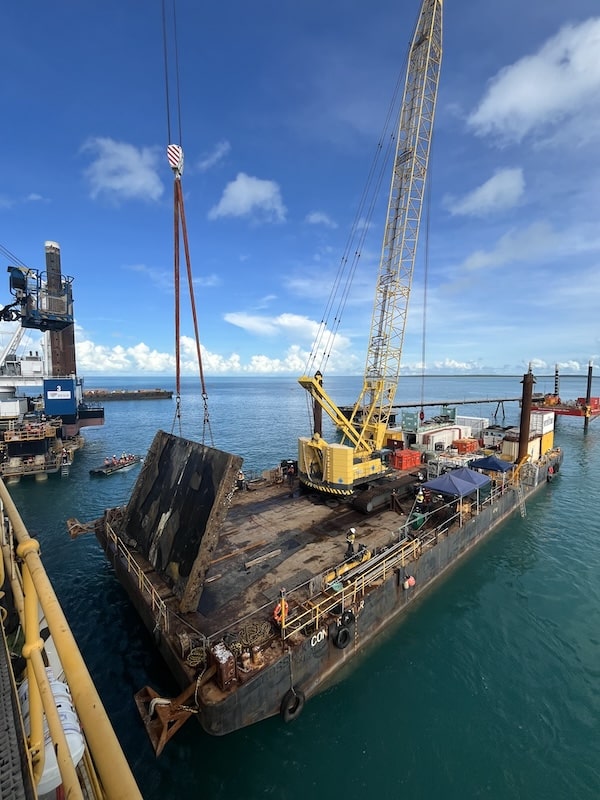
“We completed more than 500 commercial dives, all safely and without incident,” says Olivier. “This was in an environment where crocodiles and sharks are present, so additional safety measures were required. For example, divers were deployed in protective cages to ensure safe access to the seabed.”
Sonar imaging and remotely operated vehicles (ROVs) were used to identify debris and support lift planning, reducing reliance on manual intervention and improving visibility across the seabed. It turned a blind subsea environment into one that could be read, planned and acted upon.
Once enough of the damaged material had been removed, temporary stabilisation structures were installed onto the remaining piles, including an H-frame to support the shiploader and beams around the contactor house. Several units were floated into position, jacked up using the existing structure and welded into place, allowing demolition to continue with greater control.
With debris cleared, piling could begin. Seabed clearance dictated where crews could operate, with each cleared area opening a new work front. Once an area was ready, piling crews moved in, maintaining continuous progress.
“Piling was carried out primarily from jack-up barges, with 28 piles installed across the site,” says Olivier. “Limited geotechnical information meant pile driving analysis (PDA) was required for every pile, with data reviewed in real time to confirm capacity before the next installation could proceed.“
Piling, fabrication and delivery moved in lockstep. Once piles were installed and verified, modular steel units could be brought to site and lifted into position, allowing the structure to be rebuilt in stages.
Fabrication was carried out off site, with 13 units delivered ready for placement, reducing the amount of work required offshore and limiting exposure to weather delays. Olivier says this kept the program moving, with each completed section creating the platform for the next stage of construction.
Works were executed from a coordinated marine spread, with barges and support vessels operating as a single system.
“At any given time, we had two large jack-up barges, a crane barge, two flat-top barges and additional smaller platforms all operating in close proximity around the structure,” says Olivier. “That level of coordination is something I haven’t seen before and is something I’m unlikely to see again. It was a notable logistical accomplishment.”
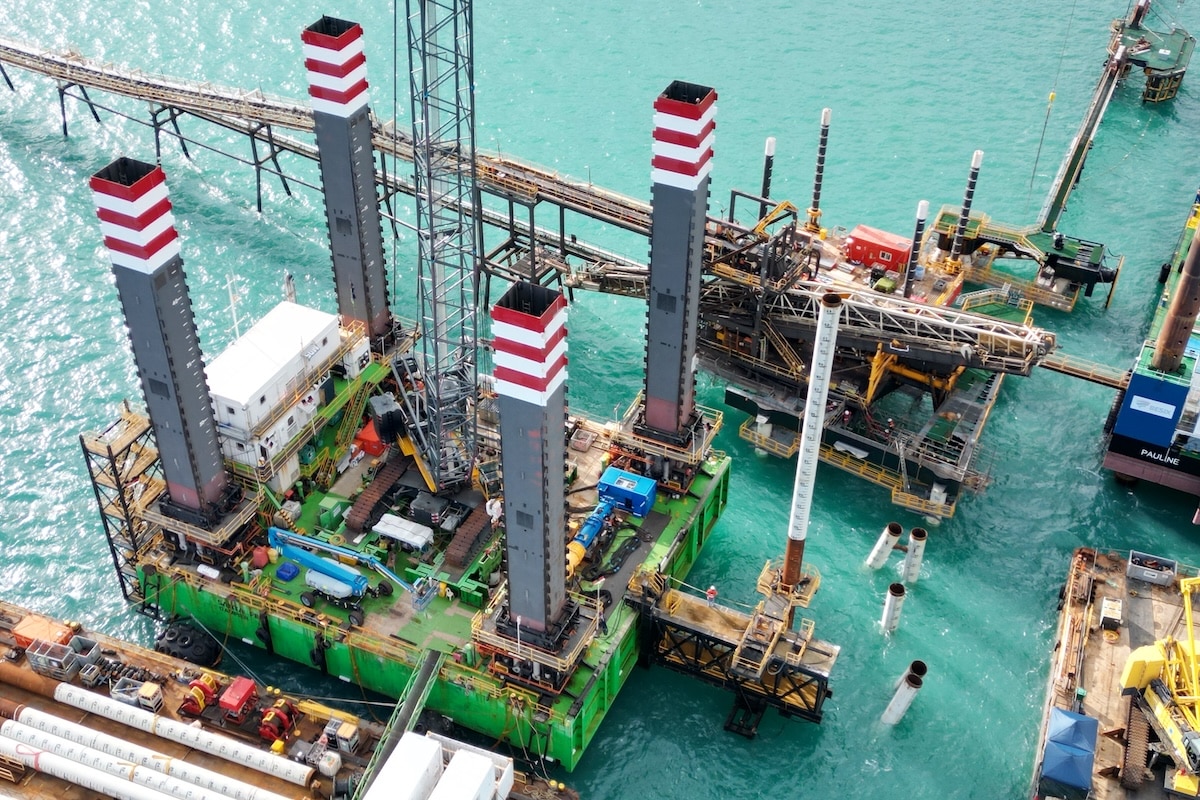
Positioning, lifting and securing each module required careful alignment with tidal windows and vessel movements, with limited offshore staging capacity adding further constraint. Activities had to be continuously adjusted to suit changing conditions, with the program driven as much by the environment as by the schedule. It wasn’t just scale, but interdependence. Every vessel, lift and delivery was tied to the next.
“If piling was delayed, the installation barge didn’t have a work front. At the same time, delivery barges bringing modules from Cairns or Darwin could be forced to wait on site even when the piles were ready. A delay in one activity affected multiple others,” says Olivier.
“We held daily meetings with the client and maintained full transparency around what could and couldn’t be achieved. The target – first ore on ship – was fixed, but the path to get there had to remain flexible.
“That meant extensive planning – days and days of working through logistics, sequencing and contingencies to understand how we would respond if something didn’t go to plan.”
The hard work paid off. Less than 12 months from mobilisation, first ore was achieved, despite working through wet season conditions that regularly disrupted crane operations and compressed available working windows. Reaching that point shifted the focus to completing the remaining works around live operations and restoring full functionality.
Prioritising what was required to safely achieve first ore, and what could follow, kept the team focused on the critical path and maintained momentum.
The outcome has since seen the project shortlisted for the Australian Construction Achievement Award, which Olivier says reflects the teamwork behind its delivery.
“This project is a powerful reminder of what can be achieved when a client and contractor come together with a shared goal and a collaborative mindset,” he says.
“The cyclone occurred in March. We were engaged in May. Mobilisation followed shortly after that, and we achieved first ore within 12 months. For a project of this scale and complexity, that is a remarkable outcome.”
The post Bringing the Groote Eylandt wharf back to berth appeared first on Inside Construction.
View Source


Comments
Post a Comment